Skip to content
  • BLOG
  • RESOURSES
    • PODCASTS
  • ABOUT
  • BLOG
  • RESOURSES
    • PODCASTS
  • ABOUT
  • BLOG
  • RESOURSES
    • PODCASTS
  • ABOUT
Category:

Uncategorized

Uncategorized

10 Attributes of a Mature Man

by Bob Rockwell November 7, 2023
written by Bob Rockwell
Age is usually one of the main words we associate with maturity. However, the reality is there is more to being mature than simply getting older. The posture of our hearts and attitude towards life says a lot more about our level of maturity.
 
Growing up, I was blessed to have a dad who was great at sharing wisdom often and then allowing my brothers and me to make choices as to whether we applied what he shared. The attributes of a mature man I share with you today originated mostly with my dad who to this day, despite the fact he is no longer with us, remains my greatest hero.
 
Unfortunately, these days some of what my dad shared with me and my brothers may at first appear to be “old fashioned” or even sexist. It is not. These attributes could be, and I think should be, applied to all men and especially to dads.  Admittedly, I grasped most of the value later as I “matured” and had children. I hope you might choose to experience the positive impact of these attributes as a dad a little earlier in your life regardless of what stage or season you are in today.
 
Here are the 10 attributes of the mature man.
 
The mature man …
 
1. Strives for personal WHOLENESS – he is committed to living free from toxic emotions or personal demons.
 

2. Focuses on GIVING more than receiving – generosity is much more than money to the mature man.

 
3. Holds a mostly POSITIVE point of view in relationships with others – he believes everyone has value, that anything is possible, and expects surprises.
 
4. Identifies as a LIFELONG STUDENT – he knows if you stop learning, you stop truly living.
 
5. Lives life from an ETERNAL perspective – he recognizes that his legacy will have a lasting impact.
 
6. Tells himself, and seeks the TRUTH at all costs – he knows the alternative: self-deception and denial costs way more.
 
7. Takes the HIGH ROAD – he is magnanimous, quick to forgive, and has a reputation as a class act.
 
8. Seeks and treasures the true wealth of close authentic RELATIONSHIPS over every other kind of wealth.
 
9. Assumes 100% RESPONSIBILITY for the strength of his marriage – it’s not up to his bride to be the first to say ‘I am sorry’ or make sacrifices. 
 
10. Understands the most powerful force in life is LOVE – he wants to reflect back on his life , and proudly say: “This is what I accomplished with my life and who I impacted for good because I truly cared about all who God put in my life.”
0 FacebookTwitterPinterestEmail
Uncategorized

12 Bold Prayers for Dads

by Olise Atenaga August 6, 2023
written by Olise Atenaga
Fatherhood is a transformative journey that requires courage, wisdom, and strength. No matter where a dad is in his life, one way to help him on this monumental journey is to pray for him. As dads, we need all the inspiration and guidance we can get to navigate the fatherhood journey with confidence and purpose. 
 
Seeking God’s help through prayer is a powerful way to connect with the strength, wisdom, and grace necessary to become the best versions of ourselves so we can fulfill our divine role as dads. 
 
Prayer changes things. Your prayers matter. If you are a dad, you can pray these 12 bold prayers for yourself, your dad, or a dad you know.
 
1. Prayer for Gratitude – Dear God, instill in me a consistent heart of gratitude for the precious gift of fatherhood. I want to cherish every moment and be grateful in all circumstances for the blessings in my family. (1 Thessalonians 5:18 NIV)
 
2. Prayer for Guidance – Guide me as I lead my family. Reveal your ways to me, guide me on the best pathway for my life, and give me the discernment to make decisions that align with your will. (Psalm 25:4 NIV)
 
3. Prayer for Strength – Lord, grant me strength and courage to face the challenges of fatherhood. Help me overcome fear and discouragement. Remind me that you are with me in every step of this journey and help me with the discipline I need to wait on you so my strength is renewed. (Joshua 1:9 NIV)
 
4. Prayer for Patience – Dear God, fill my heart with patience and kindness towards my family, especially during challenging times and seasons. Let patience and kindness be at the core of every interaction and encounter I have. Help me to love them as you love us, with a patient and enduring love. (1 Corinthians 13:4 NIV)
 
5. Prayer for Humility – Lord, help me embrace humility as a dad, so I can consistently serve my family with a humble heart. (James 4:10 NIV)
 
6. Prayer for Courageous Leadership – Heavenly Father, make me a courageous leader for my family. Empower me to stand firm in my faith and lead them with unwavering strength. (1 Corinthians 16:13 NIV)
 
7. Prayer for Integrity – Heavenly Father, guide me to live a life of integrity and righteousness. May my children be blessed and follow the godly example I set before them. (Proverbs 20:7 NIV)
 
8. Prayer for Emotional Support – Dear God, teach me to support my family emotionally. Help me carry their burdens and be a source of comfort and strength in times of need. (Galatians 6:2 NIV)
 
9. Prayer for Boundaries – Lord, help me set appropriate boundaries for my children. Give me the ability always to nurture them in your ways, guiding them with love and discipline. (Ephesians 6:4 NIV)
 
10. Prayer for Protection – God, I trust in your faithfulness to protect my family from harm. Surround us like a shield from the plans of the evil one. (2 Thessalonians 3:3 NIV)
 
11. Prayer for Financial Wisdom – Dear God, grant me wisdom in managing our finances so I can make wise choices to provide for my family’s needs. (Proverbs 21:20 NIV)
 
12. Prayer for Eternal Impact – Lord, guide me to raise my children in your ways. May the impact of my parenting lead them to a lifelong relationship with you. (Proverbs 22:6 ESV)
 
0 FacebookTwitterPinterestEmail
Uncategorized

The Power of Apologies: Why Dads Should Apologize to Their Children

by Olise Atenaga July 2, 2023
written by Olise Atenaga
In most places, Chick-fil-A is renowned as the ultimate standard for fried chicken and excellent service. So, when my 11-year-old daughter suggested we create our version of their chicken nugget, I enthusiastically agreed. 
 
It was a sweltering and overcast Wednesday evening in Texas. I hurried to the store to gather the ingredients required for the recipe she discovered online. After I navigated traffic and three grocery stores, I seriously considered reneging on my promise to do this with her. When I returned home, we embarked on the chicken preparation journey, meticulously cutting it up, whipping the batter, and combining the necessary ingredients. However, there was an ingredient that didn’t quite fit the bill: my less-than-ideal attitude.
 
Regrettably, I wasn’t fully present in this opportunity to create cherished memories with my daughter. My impatience, irritability, and distraction cut through the preparation and cooking process. Despite my awareness of my attitude and attempts to adjust, I couldn’t summon my best self that evening.
 
Nonetheless, we pressed on, successfully crafting the chicken and fries, indulging in our culinary masterpiece, and tidying up afterward.
 
As I reflected on my attitude that evening, it gnawed at my conscience throughout the night and into the following day. When I finally had a moment with my daughter, I expressed gratitude for our joint endeavor to replicate Chick-fil-A. I also apologized for my lackluster attitude, assuring her I would do better next time. In response, she smiled, gave me a warm embrace, and said, “That’s okay, Dad. I didn’t notice, but I appreciate your apology.”
 
Although a part of me remained uncertain if she had perceived my less-than-ideal attitude due to my efforts to make adjustments, I firmly believed she deserved a more positive attitude from me. Hence, it was essential for me to apologize.
 
I believe when we apologize to our children when we make mistakes, misunderstand their needs, or inadvertently cause them distress -whether our faults are glaringly apparent or go unnoticed – it serves the following purpose:
 
  • It conveys “I value you and our relationship”: An apology communicates to your child that they hold significance in your life. It signifies that you recognize and respect them enough to acknowledge when you have fallen short. Every word and action from a parent to a child sends a message. As a parent, you hold a place of power and authority in your relationship with someone dependent on you. When you transition from a place of power to a posture of humility, they perceive themselves and you differently.
 
  • It demonstrates a growth mindset: Mistakes and imperfections are inherent to our human experience. No one goes through life without making mistakes. It is easy to become overwhelmed by our mistakes and attempt to hide them instead of viewing them as opportunities for growth and improvement. When you offer an apology, you convey that you are a person in progress, capable of change.
  • It sets the stage for accountability and improvement: Apologizing communicates that you recognize something was awry and signifies your commitment to do better. By taking responsibility and apologizing, you establish a new or higher standard against which you wish to measure yourself and invite others to hold you to this new or higher standard.
 
As dads, we have a unique opportunity to shape our children’s lives. Embracing the power of apologies is an integral part of this journey. Saying “I’m sorry” is not a sign of weakness but a testament to our love, humility, and commitment to our children’s well-being. Apologies can mend hearts, deepen relationships, and create a nurturing environment where our children can thrive emotionally, socially, and psychologically.
 
 
0 FacebookTwitterPinterestEmail
Uncategorized

Teach Your Children to Have Heroes

by Bob Rockwell June 2, 2023
written by Bob Rockwell
Great dads recognize and appreciate the positive influencers in their life who have helped shape them into the men they are today. They will even describe several positive influencers as heroes if they are fortunate. Another thing about great dads is they are intentional about being a positive influence, beginning with their children.
 
In this post, I want to share an exercise I have shared with many of the executives I coach, especially around Christmastime as a “non-monetary” gift to their kids.
 
Here is how it works:
 
  • Tell your child you have three heroes in your life. Describe the traits of each that make them one of your big heroes, one after the other, without revealing their names until you share that hero’s list of traits.
  • After reading the first list, reveal the name of your first hero. This should be a person you genuinely and greatly admire.
  • For your second hero, list positive and admirable traits of your wife and then reveal to your kids that it is mom. 
  • Finally, your third hero’s traits are those you see in your child, ultimately revealing their name as your third hero.
  • If you have more than one child, you can combine their admirable traits or have more heroes! This is worth some thought, as your list of traits are what you will regularly encourage and praise them for as you observe and see them exhibited in their daily life.
 
I encourage you to document this and perhaps give it to your kids as a gift, expressing your gratitude for them and to them for the positive impact they make on your life.
 
By performing this exercise, you are communicating to your kids that you greatly admire them and their mom and that you see them becoming heroes to others someday. You are expressing your belief that your kids will be great influencers in the world and that you are proud of the people they are becoming.
0 FacebookTwitterPinterestEmail
Uncategorized

The Importance of Play and 3 Simple Ways to Get More

by Olise Atenaga April 16, 2023
written by Olise Atenaga
As a child, I grew up in a culture and era where dads hardly played with their children and weren’t expected to. Dads playing and showing their goofy, fun side was considered soft. Please understand the dads I knew, including mine, loved their children dearly, but a healthy dose of play was not part of the package. 
 
Back then, expecting your dad to engage in play was like expecting a chicken to fly. Chickens can fly, but you rarely see them flying, and when they do, it’s usually not for long and can be shocking because we are not used to seeing them fly. 
 
Many years later, when I became a dad, my dad shocked me with something he said while I was bathing my 2-year-old son.
 
My son wasn’t cooperating and had to get ready for daycare. He kept fussing, and we seemed to be getting nowhere. My dad had been watching us the entire time, and after a few minutes of my failed attempts to get my son to take a bath, he said, “He just wants to play. Try playing with him.”
 
Despite my shock at his statement, I reluctantly began to make funny faces and sounds while tickling him, and the longer we continued, the more my frustration and the tension from earlier melted off. My son relaxed. I relaxed. We were playing, and like a flash, bath time was over.
 
Play and learning are intertwined. Through play, you learn about yourself, your child, and the people and world around you. Play is a simple joy that’s a cherished part of childhood and adulthood. 
 
As men, play can sometimes be the last thing on our minds for many reasons, such as a packed schedule, physical and mental fatigue, and fear of rejection or ridicule if we try to be lighthearted and playful. You are not alone if you feel this way. I also struggle with self-consciousness and concerns about unleashing my inner child and playfulness. However, consider that children are incredibly creative, always inventing and constantly learning, partly because they have no reservations about play.
 
If you have ever thought of play as frivolous, here are some helpful benefits to reframe your view of play:
 
  • Play is connecting time – It enables us to take a break from the hustle and bustle of everyday living to experience and enjoy life with the people we care about in unstructured, fun, imaginative, and creative ways. 
  • Play is a stress reliever – When we are playing, we are having fun. It may not be long, but it’s always a good time. It allows our bodies to release natural feel-good chemicals that provide an overall sense of well-being. 
  • Play strengthens emotional connections – Playing creates a safe space to explore our emotions and connect with other people on an emotional level. During play, we get the opportunity to experience empathy, trust, and intimacy. 
  • Play enhances brain function – Cognitive improvement can come through playing games or other fun activities. Play stimulates the mind, boosts creativity, helps improve your brain’s functionality, and averts memory problems. 
 

3 ways to develop the habit of play:

 
  • Schedule it. Block out some time on your calendar to play with your kids, a friend, or alone. Whatever gets on your calendar usually gets done. Choose a length of time that is sustainable for you. Make it as easy as possible to get started. It could be as little as five minutes. Don’t worry about the outcome. Focus on mastering the art of showing up. 
  • Do it. You have blocked out time on your calendar but don’t feel like playing. What do you do? Show up! Playing might not feel like the adult thing to do if you have bought into the idea that play is for kids only, especially when you have other things pulling your attention. Just like you don’t feel like going to the gym but do it anyway and feel great after your workout, that’s what happens (minus the burning muscles) when you do it.
  • Track it. If being playful doesn’t come naturally, tracking your playtime can help you turn it into a habit. Putting playtime on your calendar protects that time, and tracking is how you record that it got done. There are many tools you can use to achieve this. I use an app from the ios app store called Done. Having a method of recording your playtime enables you to review your progress so you see how well you’re doing, and it can also serve as a motivator to keep you going as you see your progress build up.
0 FacebookTwitterPinterestEmail
Uncategorized

7 Ways You are Leading Like a Tyrant, and How You Can Make the Shift to Lead Like a King Instead

by Brett Gibbons April 15, 2023
written by Brett Gibbons
 I have heard it said a number of times that as husbands and fathers, we are always filling one of three central roles. They are prophets, priests, and kings. In the prophet role, we may be giving advice, or scripture to help solve a problem or come to a healthy conclusion to a conflict. As priests, we listen and then pray for intercession from God. The last role is one I would like to discuss further today, the king role.
 
In the king role, we are leading. We are taking charge, making decisions, defending, encouraging, providing security, and being an example to our children. We are setting rules and expectations, and ideally, leading as selfless servants. In 1 Timothy 3:4, Paul states, “Mature masculinity governs its household well.” But what happens when kingship goes off the rails? All too often I believe we begin leading like a tyrant.
 
The word tyrant is first seen in English and French around 1290, originating from the Latin, tyrranus, meaning “illegitimate leader” which was originally found in the Greek word, tyrannos or “monarch, ruler of a city”. The Greeks may have had a lot of things wrong, but I feel they nailed it on the understanding of a king vs a tyrant. Philosopher, educator, and popular author, Mortimer J. Adler said:
 
“The Greek philosophers stressed the quality of rule rather than legitimacy. Both Plato and Aristotle speak of the king as a good monarch and the tyrant as a bad one. Both say that monarchy, or rule by a single man, is royal when it is for the welfare of the ruled and tyrannical when it serves only the interest of the ruler.”
 
He goes further to state that although the bible didn’t use the word tyrant, the author, God, and the writers shared the same feelings about tyrant leaders.
 
Examples of this can be found in Proverbs 28:15–16, “Like a roaring lion or a charging bear is a wicked ruler (the tyrant) over a poor people. A ruler who lacks understanding (the tyrant) is a cruel oppressor, but one who hates unjust gain will enjoy a long life.” Also in Proverbs 29:4, “By justice, a king gives stability to the land, but one who makes heavy extractions (the tyrant) ruins it.”
 
So now that we established a tyrant leader is not and has never been a good thing, let’s define what exactly is a tyrant so we can then identify what that looks like in real-time.
 
Knowyourarchetypes.com shares:
 
  • The archetypal Tyrant is filled with anger and rage.
  • The anger which fills the Tyrant can lead them to hit out at others, doing so and inflicting pain giving them an increased sense of empowerment that is otherwise missing in their life.
  • They display hatefulness, envy, and abusiveness towards others as a result of their need to make themselves feel better about their own weaknesses.
     
Men… that sounds horrible! My first thought is, I would never act like this – weak, leading from a mindset of scarcity, not abundance, afraid to share any sort of power, often needing to put people “in their place”, or demanding “you are going to listen to me or I am going to…. fill in the blank.”
 
But how easy is it to come home, tired, maybe carrying some hostility from work, and swing over to the tyrant leader? Stack on weeks, months, and possibly years of this type of work stress, financial stress, family stress, etc. and we can see how the reality of becoming a tyrant is absolutely possible. It’s even more believable if we ourselves had no example of what king leadership looks like when we were growing up.  Whatever the reason, the enemy will use any foothold he can to disrupt your household. Turning you into a tyrant is definitely in his repertoire of tricks to do so.
 
So, what are some signs you might be leading from the tyrant model and not the king leader:
 
  • Leading with an iron fist “My way or the highway, there is no other way.” Absolute power.
  • Being unwilling to discuss our reasoning with our children.
  • Dismissing our children when they want to ask questions.
  • Withholding attention and putting in place our own interests (social media addiction would be a great example).
  • Seeing our children as a burden and not a blessing.
  • Putting more importance on our hobbies, or possessions than our children.
  • Giving love when it is convenient, withholding love when angry.
 
Now let’s take a look at what a Servant king looks like:
 
  • They take time to listen. The good king puts down what he is doing and delights in hearing his children’s successes, failures, and stories.
  • They give love freely and show empathy. They care about their children’s issues and try to see them from their point of view.
  • They are aware and present. Pastor James DeMello states this quality beautifully in his book, Andrizo Man: A Call to Distinctive and Authentic Manhood. In it, he leads us to support from the bible found in 1 Corinthians 16:13 which states “Be watchful, stand firm in the faith, act like men, be strong.”
  • Servant leaders are selfless. They understand the big picture: it’s really about the success of those around you, in this case, the children. 
  • Servant leaders give encouragement. Man, how good does it feel to be told you have done a good job! To be loved unconditionally and to be told you are doing a good job is the delight of child and man alike. I want to hear my heavenly father tell me, “Good job son, I love you.”
 
So how do we know if what we are doing is of a servant king or a tyrant? Men, we have to filter our behavior…every day. Just like coffee or wine, the filtering comes at the very end before it is consumed. It is for cleaning the substance, making it brighter, and catching any filtrates, chaff, or “junk” from coming through and affecting the taste.
 
We have to be intentional about looking at ourselves daily through the eyes of our heavenly father. If we become lazy in this, we are not being watchmen and are in jeopardy of becoming a tyrant. We also need to be in God’s word, praying for intercession in our lives by God to convict us of those areas that need change, and then be open and ready to make those changes with His guidance.
 
As Christians, we have such a great picture of what it looks like to lead as a servant king. In Matthew 20:26-28 Jesus tells us, “It is not this way among you, but whoever wishes to become great among you shall be your servant, and whoever wishes to be first among you shall be your [willing and humble] slave; just as the Son of Man did not come to be served, but to serve, and to give his life as a ransom for many.”  Such an awesome picture of a good, kind, serving king!
 
Today, take a minute to examine yourself. If you find that you have indeed been leading as a tyrant, give yourself some grace! Many of us have been there at one time or another. But I would encourage you to pray for heart change, pray for God’s wisdom, to be filled with God’s love. Then, daily, filter your actions and behaviors through the eyes of a servant king.
0 FacebookTwitterPinterestEmail
Uncategorized

Raising Daughters – 4 Major Things You Provide As a Dad and How to Talk About It

by Bob Rockwell March 5, 2023
written by Bob Rockwell
In this blog post, we will explore 4 major things you provide for your daughter as a dad. I share this with leaders I coach who have daughters, and while it is especially impactful to share with daughters in their teen years, I believe it can be impactful when they are adults as well.
 
It can also be offered by a third party (grand parent or close family friend, church youth leader, etc.), as daughters can sometimes hear better from another mature adult who cares about them, than their own father. But a dad can use this for a powerful time with his daughter.
 
It can also be beneficial for teenage sons to either be there when it is shared, or for you to have a one-on-one with your son separately to explain this to him – it will help him become the man described at the end of this article.
 

The best way to begin this conversation with your daughter is to ask her what she believes are the 4 major things a dad provides for a daughter. She may guess them all, but you ultimately explain it as follows (don’t just list – explain each):  

  1. Love – Let her know you love her more than she could ever understand. Remind her that other than her mom, she is the woman you love most on earth, and that your love is unconditional.  
  2. Protection – This a great follow on from number one. Here you get to reiterate your love for her, and how it motivates you to protect her, even with your life. Communicate your commitment to do everything in your power to keep her safe always as she rests in your love for her.
  3. Provision – Describe how you love to see her smile and be happy in the life you work hard to provide for her. Explain to her that the reason you work hard and make sacrifices is because you want to make sure she is well provided for.  Share with her how much it delights you to give her as much as you can – not just the basics of food and shelter, but also gifts and experiences.
  4. Destiny – Express your desire  to see her become the woman she is meant to be. Talk about your calling and commitment as her dad to encourage, teach, correct, praise, and involve yourself in her life so that she can live life to the full, expand her gifts and talents and develop her unique personality.
Another reason having this conversation with your daughter is so powerful, and why the relationship between a dad and daughter is such a unique one, is that you will be giving up your special position to the right young man someday. When your daughter is young, you are the most important man in her life. Giving up that position and willingly taking a number two position is not something you will do lightly, or to the wrong person, which is why you are so protective in the first place. You know what is ultimately at stake.
 
As a dad to a daughter, when the time for her to get married gets closer, you are looking diligently at every guy she brings home to see if that young man has the ability to provide these 4 things for your daughter. You want to see a young man who loves her more than any other woman on earth, and loves her so much he would die for her. One who has prepared himself to make a good living to provide a wonderful life for your daughter,  is mature and assured of his own identity, so that he focuses on helping your daughter become the woman she is meant to be.
 
But until the right one comes along, every young man will be considered a potential thief or imposter, wanting to steal what belongs to the right man. Some day, when that right young man comes along, you will recognize him and so will your daughter.
 
 
0 FacebookTwitterPinterestEmail
Uncategorized

Let’s Get Ready to Rumble! (How Play Can Instill Life Enhancing Skills in Kids)

by Brett Gibbons January 14, 2023
written by Brett Gibbons

Every evening after dinner, not before, something comes alive in my son. He begins by eyeing me down from about ten feet away, then slowly steps toward me like a lion cub working on his stalking. Step by step, inch by inch, he creeps until gets within a few feet. Then all of a sudden he yells and jumps on me…the fight is on! This activity has been something that is not only looked forward to, but expected since he was around two years of age.

Several months ago, I was gone on a hiking trip through Zion National Park. When I returned my wife recanted something she noticed when she tried to stand in for me after dinner. She told me that per usual after dinner, my son wanted to wrestle. So, she tried to “act like me” and wrestle him as she has seen me do. But, after a few minutes my son got aggravated at her and quit. 

Were her sweet moves not good enough? Was she physically unable to challenge a three-year-old?  No. He didn’t want to wrestle her because she was not me. She was not the father. She was not the man who he seeks to impress, to get encouragement from, to beat, to be like one day. He could tell, even at age three, something was different between mommy and daddy.

The benefits of rough housing our children, specifically the boys have been thoroughly documented. A quick google search will lead you to many psychology studies, articles, and books emphasizing the need for men to put down the phone, look at their sons in the eyes, and roll around on the floor with them. 

One of my favorite authors, John Eldridge, recounts in his book, Wild at Heart, (which I suggest all men have on their must-read list) how boys communicate and feel love so much differently than girls. How they yearn for excitement, adventure, to be the complete opposite of tame, to know they are strong, through physical exertion. 

Rough housing teaches resilience, done correctly it teaches confidence not only in themselves but how to be confident around other men. It shows our children that they are capable, and strong, and it gives them a platform to show dad how big they are, and it gives dad a platform to encourage and challenge them.

I would challenge every man to go home tonight and get on the floor with your son. Set up a “perch” for him to jump off the couch, the “top rope” onto you. Teach him to roar, show him your roar! Knock him down. Let him knock you down. Encourage him to get up and keep going. Tell him, no show him that he is so strong and that one day he will be stronger than you are. Let him win and when he does make a big deal out of it. Believe me, if you do this, you are going to see your son come alive in ways you have never seen before.

Most importantly, however you choose to implement this rough housing or wrestling, make sure it is done out of love. Every time I am wrestling my son, it is a time filled with laughter and grunts. It is not my goal to dominate or intimidate. This will have the opposite of the desired effect. 

Remember this is a time for him to grow. A time to be bold with no judgement. This is a time for him to bond with his father, and a time for you to fill your son with a feeling of success.    


0 FacebookTwitterPinterestEmail
Uncategorized

Fatherhood And Father Time Make Masters Different For Tiger Woods

by Don Yaeger December 25, 2022
written by Don Yaeger
After starting the day bright and early to avoid the threat of thunderstorms, the 18th hole of Augusta National was hit by a roll of thunder no meteorologist could have predicted.
 
But no one panicked. No one ran for cover. No one cried—unless they were tears of joy.
 
That’s because, in the midst of Augusta’s loudest roar since 1986, attendees at the Masters were treated to something they’d not seen in 14 years:
 
After four surgeries, several public failures, and breathless speculation, they saw Tiger Woods slipping on his fifth green jacket.
 
From the beginning of the week, the Tiger chatter was prevalent. After his win at the 2019 Tour Championship in Atlanta, there were plenty of golf fans who felt like Tiger was back. There were just as many who felt Woods was past his prime, a victim of bad health and self-inflicted bad decisions.
 
Woods was among them.
 
“I was done,” he told ESPN’s Mark Schlabach describing his feelings about his future as recently as a year ago. “[Coming off of back surgery] golf was not in my near future or even the distant future. I knew that I was going to be a part of the game, but play the game again, I couldn’t even do that with my son Charlie. I couldn’t even putt in the backyard.”
 
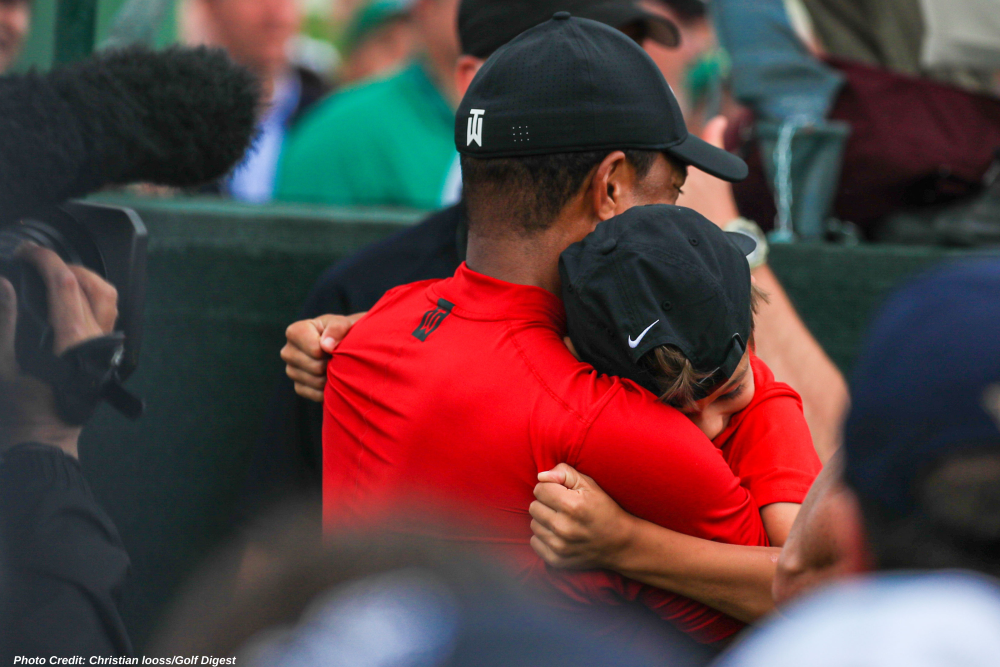
After his putter delivered him a Masters victory, the win delivered Woods into the arms of his waiting son. There, just off the side of the 18th green, an older, wiser Tiger Woods held his son in his arms. Immediately after Charlie, Woods hugged his mother, Tida, and then his daughter, Samantha.
 
Woods’ children had never been to Augusta before 2019. Neither was even born the last time Tiger won at the Masters. Samantha was born in 2007; Charlie in 2009.
 
I remember having the opportunity to cover Tiger in his prime—he was a force, a man so talented he could dominate a field by sheer power of will. The Tiger Effect—the psychological crumbling of some of his youthful contemporaries—was never more prevalent than at Augusta during those years. With his bombs off the tee and his furious desire to win, Woods routinely cowed the best the game had to offer.
 
But what we saw at the 2019 Masters Tournament was not prime Tiger Woods. He wasn’t long off the tee—he barely made the top 40 in driving distance—and his desire to win wasn’t as obviously searing as it once was. Woods often looked contemplative, and on some occasions seemed to be calming himself down instead of psyching himself up.
 
Tiger Woods looked like what he was: a 40-year old father just trying to make his kids proud.
 
As a father myself, I can tell you few things are as humbling as age and children. The week before the 2019 Masters Tournament I had surgery on my bicep (after I tore it in a pick-up basketball game) and my buddies wouldn’t let me hear the end of it. And there are days when my children seem to speak an entirely different language, half of it based on emojis.
 
But what Father Time and fatherhood provide is patience, and patience is an old(er) person’s gift. It certainly was a gift for Tiger —while other players were stretching themselves in their chase for the green jacket, Woods played within himself and trusted his experience to keep him straight.
 
It served him well. Woods was second in greens hit in regulation, and top 15 in putting. He played like an old man and became the second oldest to ever win the Masters. The guy who is the oldest to ever win tweeted out a simple message of congratulations.
 
A big “well done” from me to @TigerWoods! I am so happy for him and for the game of golf. This is just fantastic!!! @TheMasters
 
— Jack Nicklaus (@jacknicklaus) April 14, 2019
 
And now Woods sits at 15 majors, only three behind Nicklaus’ record of 18. A record Woods has long desired, but for the last decade has seemed out of reach. With Tiger roaring again at Augusta, maybe the hunt is still on.
 
Or maybe it won’t be. This seems like a different Tiger Woods. More settled. More joyous. More at peace with himself and his place in the world.
 
Sometimes, the goals we chase when we’re young don’t hold up the way we imagined. We fight hard for success, making sacrifices we believe will be justified by our achievements. But with time and distance—with age and changing circumstances—we come to realize what we once thought mattered doesn’t matter the way it once did.
 
Call it the privilege of growing old. Call it the power of parenthood. I call it the biggest blessing of my life and given Tiger’s smile as he grabbed his son into a hug, I think he would agree.
 
Success is sweet.
 
But knowing what kind of success matters the most to you is even sweeter.

This article was originally published on forbes.com


0 FacebookTwitterPinterestEmail
Uncategorized

3 Ways You Can Practice Gratitude with Your Child

by Olise Atenaga November 22, 2022
written by Olise Atenaga
When was the last time someone expressed heartfelt appreciation for something you did? How did it make you feel?
 
Being the recipient of gratitude never gets old. We relish it because it significantly increases our happiness and impacts our overall well-being. Being on the receiving end of gratitude can also lead to increased resilience. It activates and strengthens our neural pathways allowing us to access new ways of thinking and living.
 
Like adults, kids relish being appreciated too. And you can give your child the benefits associated with gratitude by mindfully practicing thankfulness in your interactions with them using the following three tips:
1. Say “thank you” often
From the moment they could speak, saying “thank you” was non-negotiable for my kids. And almost every parent says the same. If saying “thank you” is a good expectation for our kids, it should be the same for us as parents.  When you express thanks often (even to your kids) you set the example and make it easier for them to do the same and reap the benefits associated with an attitude of gratitude. 
 
Depending on where you live and grew up, the need for adults to say “thank you” to kids can easily be overlooked due to cultural norms. Growing up as a kid, I was rarely acknowledged for  completing certain tasks that were my responsibility with a “thank you” because it was my job to get it done. I find myself doing the same often with my kids and have to remind myself to express thanks to them even when they complete tasks that are their responsibility.
 
No matter how often we repeat it,  saying “thank you” never diminishes in its meaning and ability to make people feel seen, loved and appreciated.
 
2. Show appreciation for effort, regardless of outcomes
Not everything you ask your child to do will turn out right or be executed to the standards you like. They will make mistakes, rush through the assignment and not give it their full attention. Rather than get upset or communicate your disappointment, view the situation as an opportunity to express your gratitude for the effort they put into getting the task done to the level they did.
 
Appreciating their effort doesn’t mean you settle for an incorrectly or half completed task. Not at all. You can use this as a learning moment to either demonstrate or provide clear instructions on how to complete the task and what your expectations are.
 
Taking this approach helps you model what a growth mindset looks like. It communicates that their ability is not fixed, that there’s room to grow and get better, and you are there to help them.
 
3. Be specific in your gratitude
Specificity when you express gratitude to your child helps them understand exactly what they did and the impact. It makes it repeatable.
 
Rather than simply saying to your daughter, “thanks for getting ready early”, you could get specific and say, “thanks for getting ready on time this morning, Jessy. It allowed me to drop you off at school, and make it to work early with 25 minutes to spare before my big presentation to a new customer today. Getting to work early helped me feel relaxed and prepared for the presentation. I appreciate your help.”
0 FacebookTwitterPinterestEmail
Newer Posts
Older Posts

Recent Posts

  • Six Habits That Build Strong Parent-Child Relationships 

  • 5 Ways to Respond to Failure

  • Celebrating Father’s Day: 25 Inspiring Reminders Every Dad Needs to Hear 

  • 12 Books That Will Change How You Lead As a Dad

  • 5 Essential Qualities to Develop as a Dad

  • 8 Great Books on Positive Parenting and Raising Good Humans

Newsletter

GET FATHERHOOD INSIGHTS IN YOUR INBOX!

Facebook Twitter Instagram

©2023  FATHERHOODGOLD

FACEBOOK

|

TWITTER

|

INSTAGRAM

  • FACEBOOK
  • TWITTER
  • INSTAGRAM
Subscribe to the Fatherhood Gold Newsletter

Receive great ideas, actionable insights, and resources to help you in your fatherhood journey all delivered to your inbox.

First Name
Enter your email address

No thanks